پسو سرکس کی تاریخ

زمین پر سب سے چھوٹے شو کی چار صدیوں سے زیادہ

Origins: The Metalworkers’ Tradition (1500s–1700s)

The story of the flea circus begins not as entertainment, but as a demonstration of extraordinary craftsmanship. In the 16th and 17th centuries, watchmakers, goldsmiths, and blacksmiths created impossibly small metalwork and used living fleas to prove how lightweight and delicate their creations were.

In 1578, London blacksmith Mark Scaliot produced “a lock consisting of eleven pieces of iron, steel and brass, all of which, together with a key to it, weighed but one grain of gold.” He also made a chain of gold consisting of forty-three links and, having fastened this chain to the lock and key, put it around the neck of a flea, which drew them all with ease. The entire assembly—lock, key, chain, and flea—weighed only one and a half grains.

Around 1743, a watchmaker named Sobieski Boverick presented to the Royal Society an ivory coach-and-six complete with coachman, passengers, footmen, and a postillion—all drawn by a single flea. The microscopist Henry Baker introduced him at the meeting on 9 June 1743.
Robert Hooke’s Micrographia (1665)

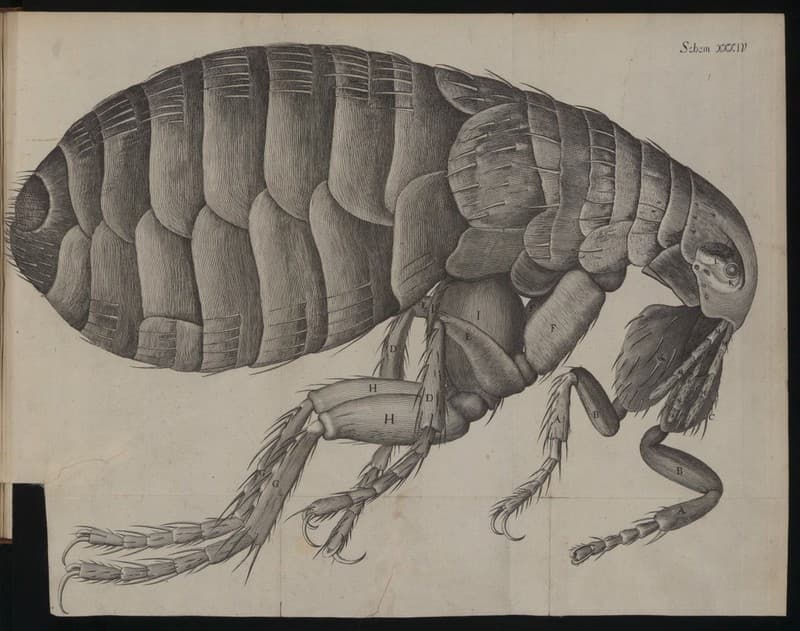
Robert Hooke's engraving of a flea from Micrographia, 1665
Robert Hooke's flea engraving from Micrographia (1665). Wellcome Collection, CC-BY.

Robert Hooke’s landmark Micrographia (1665)—the first major publication of the Royal Society—included a famous large fold-out illustration of a flea as seen through a microscope. Hooke wrote: “The strength and beauty of this small creature, had it no other relation at all to man, would deserve a description.” He described the flea as “adorn’d with a curiously polish’d suite of sable Armour, neatly jointed.”

The book became a sensation. Diarist Samuel Pepys wrote on 21 January 1665 that it was “the most ingenious book that ever I read in my life.” This popularization of the microscopic world helped fuel later public fascination with fleas and flea performances.

The First Flea Circus (c. 1812)

The earliest mention of a flea circus as entertainment—rather than a craftsman’s display—dates to around 1812 and the performances of Johann Heinrich Deggeller, a goldsmith from Stuttgart, Germany. His fleas could drag “the first-rate Man of War of 120 guns,” fight with swords, and draw a two-wheeled carriage.

Deggeller marks the transition from skilled tradesmen demonstrating their miniature work to a genuine form of popular entertainment in its own right.

Louis Bertolotto’s “Industrious Fleas” (1820s–1850s)

Born in Genoa, Italy, Louis Bertolotto was the first flea circus impresario to achieve international fame. He established his “Extraordinary Exhibition of the Industrious Fleas” at 209 Regent Street, London, in the 1830s, charging one shilling admission.

His acts included four card-playing fleas, a flea orchestra allegedly playing audibly, an Oriental mogul with a harem, a fancy-dress ball with six-legged ladies and gentlemen dancing to a 12-piece orchestra, and a climactic Battle of Waterloo tableau featuring Wellington, Napoleon, and Blücher in full uniform.

Bertolotto published several editions of The History of the Flea, with Notes and Observations. He also performed in New York (1835) and Toronto (1844) before emigrating to Canada in 1856. Charles Dickens referenced his “Industrious Fleas” in Sketches by Boz (1836).

The Golden Age (1870s–1930s)

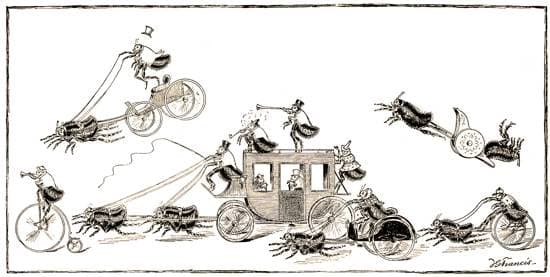
The Go-As-You-Please Race — fleas riding bicycles and pulling carriages, 1886
"The Go-As-You-Please Race, as seen through a Magnifying Glass." St. Nicholas Magazine, 1886. Public domain.

Flea circuses peaked in popularity during the late Victorian and Edwardian eras, thriving as part of the broader culture of dime museums, sideshows, and curiosity exhibitions.

An 1869 London exhibition featured “fleas of all sizes, ages, and complexions drawing all manner of miniature vehicles: fleas running four-in-hand, fleas running tandem, fleas doing mail-cart service, fleas driving locomotives; one flea doing steam-tug work, and pulling a line-of-battle ship some thousand times larger and heavier than himself.”

By the early 1900s, flea circuses were regular features at traveling carnivals, seaside resorts like Coney Island, music halls, and World’s Fairs. The broader sideshow golden era lasted from roughly 1870 to 1920.

Professor Heckler’s Flea Circus at Hubert’s Museum (1900s–1960s)

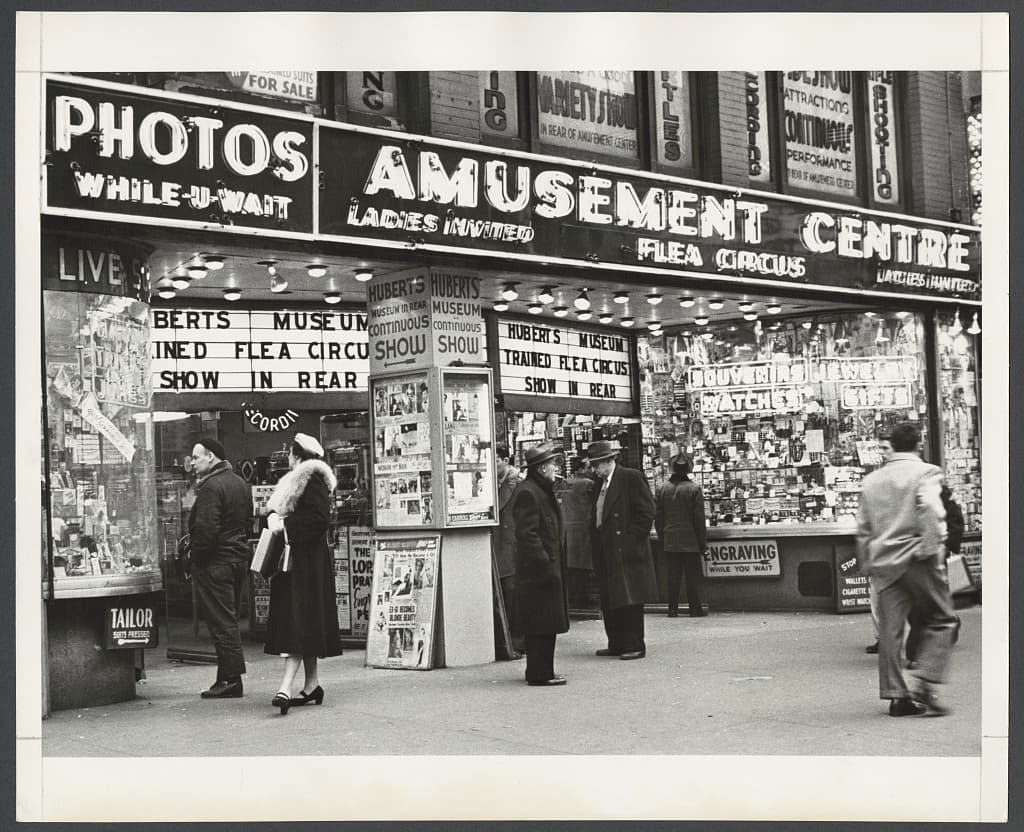
Hubert's Museum and Flea Circus storefront on 42nd Street, New York
Hubert’s Museum & Flea Circus, 42nd Street, New York. Library of Congress.

William Heckler, a native of Switzerland who began his career as a circus strongman, presented his flea circus at the 1904 St. Louis World’s Fair and later at Coney Island. In 1915 he published Pulicology, a pamphlet on the “science” of training fleas.

Around 1925, Heckler moved his show to Hubert’s Museum at 228 West 42nd Street, Times Square, where the flea circus became a legendary New York institution. After William died in 1935, his son Leroy “Roy” Heckler ran it until his retirement around 1957.

Notable visitors included Jack Johnson, the former heavyweight boxing champion, who worked as a shill for the show in 1937. By the time Jon Voight walked past the building’s facade in the 1969 film Midnight Cowboy, Heckler’s—apparently the last flea circus in the United States—had already closed.

How Real Flea Circuses Worked

Flea circuses used the human flea (Pulex irritans), chosen for its relatively large size. Fleas were fitted with tiny harnesses of thin gold or copper wire looped around the thorax. The binding pressure had to be exact—too tight and the flea could no longer swallow and would die.

Fleas cannot truly be “trained” in any conventional sense. Instead, performers observed individual fleas to determine whether they had a predisposition for jumping or walking, then assigned them to different acts. Jumping fleas kicked lightweight balls; walking fleas pulled miniature carts and chariots. “Fencing” fleas had small pieces of metal glued to their forelegs—when they tried to shake them off, they appeared to be sword-fighting.

Heat was a key control mechanism. Applying warmth from below caused all harnessed fleas to start moving vigorously, creating the illusion of dancing or performing. Performers typically fed their fleas by allowing them to bite their own arms once per day.

Fleas can jump up to 150 times their own body length and pull objects up to 20,000 times their own body weight. Their jumping is powered not by muscle alone, but by blocks of resilin—a rubbery, spring-like protein in the thorax—that allows them to exert about 100 times more power than muscle alone.

“Humbug” Flea Circuses

Many flea circuses, particularly those operated by magicians, used no real fleas at all. Magnets, hidden wires, electric motors, and mechanical gimmicks operated tiny trapezes and moved miniature figures. Optical illusions using magnifying glasses enlarged the mechanisms for audience viewing.

This is the type of flea circus referenced in Steven Spielberg’s Jurassic Park (1993), in which John Hammond recalls: “You know the first attraction I ever built when I came down south from Scotland? It was a Flea Circus, Petticoat Lane. Really quite wonderful. We had a wee trapeze, and a merry-go… carousel and a seesaw. They all moved, motorized of course, but people would say they could see the fleas.”

Belle Vue’s Flea Circus (1960s–1970s)

Professor Len Tomlin operated one of the UK’s last genuine flea circuses at Belle Vue Zoological Gardens in Manchester during the 1960s and 1970s. His acts included harnessed human fleas racing chariots, pulling a garden roller, riding a tricycle, and “fencing fleas” scrabbling at pins stuck in pieces of cork.

Len and his wife Evelyn employed professional insect catchers to maintain their flea supply. The circus closed in the late 1970s when improved domestic hygiene made human fleas too difficult to source.

The Decline of Flea Circuses

Several converging factors drove the decline of flea circuses after World War II. The widespread adoption of vacuum cleaners, washing machines, improved sanitation, and synthetic textiles made the human flea (Pulex irritans) increasingly rare. Operators who depended on a steady supply found it progressively harder and more expensive to source performers.

In 1935, a dozen fleas cost about 2 pence. By the 1950s, a dozen cost six shillings, and during shortages a single flea could cost two shillings. Meanwhile, television, cinema, and amusement parks drew audiences away from the intimate curiosity exhibitions that had sustained flea circuses for over a century.

Flea Circuses in Culture

Flea circuses have left a surprisingly deep mark on popular culture. In literature, the tradition stretches from Aristophanes’ The Clouds (c. 423 BC), which includes a joke about measuring the distance of a flea’s jump, to John Donne’s metaphysical poem “The Flea” (c. 1590s) and Charles Dickens’ references in Sketches by Boz (1836).

In film, Charlie Chaplin conceived a flea circus comedy routine as early as 1919 for an unreleased short called The Professor, finally filming it for Limelight (1952). Laurel and Hardy featured a flea circus in The Chimp (1932). Pixar’s A Bug’s Life (1998) features “P.T. Flea” (voiced by John Ratzenberger), a greedy flea ringmaster whose name parodies P.T. Barnum.

The most famous modern reference is John Hammond’s monologue in Jurassic Park (1993), where the flea circus serves as a metaphor for entrepreneurial illusion versus the desire for authenticity.

Modern Flea Circuses

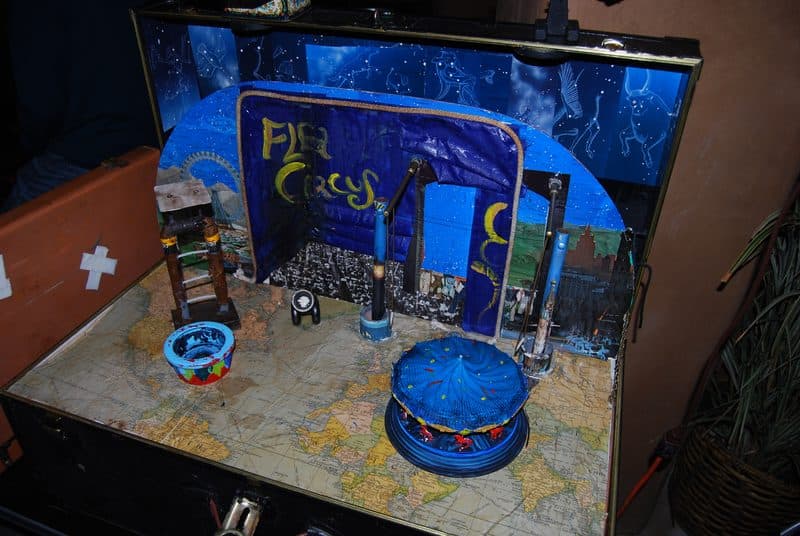
A real flea circus setup in a suitcase, with tiny stage, props, and painted backdrop
A modern flea circus by Maxfield Rubbish, San Diego. Photo by Roebot, CC BY-SA 2.0.

A handful of performers keep the tradition alive today. Professor Adam Gertsacov has toured his Acme Miniature Flea Circus across the United States and Canada since 1996, returning the flea circus to Times Square in 2001. His fleas race chariots, walk tightwires, and get shot from a cannon through a flaming hoop.

Colombian-born artist Maria Fernanda Cardoso spent six years developing a flea circus as a fine-art project. Her fleas walked tightropes, pulled chariots, and danced tango. The work toured the Sydney Opera House, Centre Pompidou, and the New Museum in New York before being acquired by the Tate Gallery in London.

Zoologist Dr. Tim Cockerill recreated a working flea circus for the 2010 Royal Institution Christmas Lectures and has trained fleas for BBC television. In Munich, the Mathes family flea circus has been a fixture at Oktoberfest since 1948—one of the world’s last genuine flea circus acts, with over 75 years of continuous performance.

FleaWinder™: The Digital Flea Circus (2026)

In 2026, FleaWinder™ brought the flea circus into the digital age. A tiny animated circus that lives above your Windows or macOS taskbar—and now in your pocket on iOS—FleaWinder™ is powered entirely by your everyday use. Keystrokes, mouse movements, clicks, taps, swipes, and shakes build up energy that drives seven live acts: a tightrope walker, trapeze artist, cannon show, strongflea, unicycle rider, juggling flea, and fire breather.

Where Victorian showmen harnessed real fleas with gold wire, FleaWinder™ harnesses your input with code. Where Heckler’s audience crammed into a walled-off corner of Hubert’s Museum basement, FleaWinder’s circus performs in a 150-pixel strip that never gets in the way. The tradition of the smallest show on Earth continues—no fleas were harmed in the making of this circus.

Timeline

ذرائع اور مزید مطالعہ